ADHD Tax - The Hidden Cost of Forgetting Things
2026-03-30
ADHD tax: the hidden cost of forgetting important things
If you have ADHD, you’ve probably paid the ADHD tax more times than you can count.
Late fees. Missed appointments. Forgotten subscriptions. Rebuying things you already own because you forgot where you put them. Booking something twice. Not booking something at all. Paying extra because you remembered the important thing 3 days too late and now the cheap option has vanished into the void.
It’s not usually one huge dramatic disaster (although, sure, those happen too). It’s the constant drip-drip-drip of small forgotten things that quietly cost money, time, energy, and a frankly offensive amount of self-esteem.
And the frustrating part? A lot of the things that create ADHD tax aren’t hard. They’re not impossible. They’re just the kind of “important but not urgent until suddenly they are” tasks that ADHD brains are famously bad at holding onto but cost you money when forgotten.
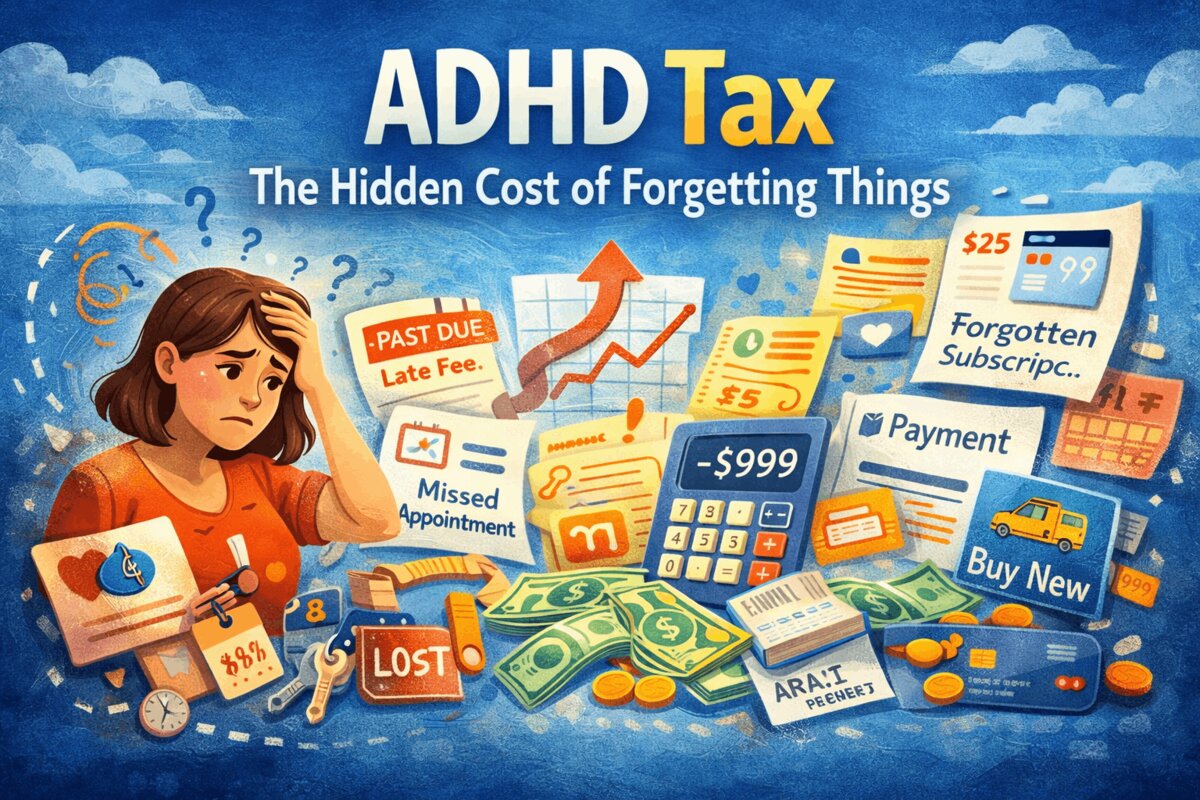
What is ADHD tax?
“ADHD tax” is the unofficial name for the extra costs that come from living with ADHD.
Not because you’re irresponsible.
Not because you don’t care.
Not because you’re “bad with money.”
Because remembering, prioritising, task-switching, estimating time, and acting at the right moment are all things that can be genuinely harder when your brain runs on chaos and side quests.
ADHD tax can look like:
- paying a bill late because you meant to do it “later”
- forgetting to cancel a free trial before it becomes a paid subscription
- missing an MOT, service, or insurance renewal
- not returning something before the deadline
- paying rush shipping because you forgot a birthday was coming
- replacing household stuff because you forgot to buy the cheaper refill in time
- missing a discount, deal, or early booking window
- forgetting a repeat prescription, appointment, or school deadline
- realising you were supposed to organise something... yesterday
It’s rarely about not being capable.
It’s about not being reminded at the right moment, in the right way, with low enough friction to actually do the thing.
Why important things are so easy to forget
A lot of “important” life tasks have one thing in common:
They’re not urgent right now, and then suddenly, they really are.
And that’s where they become invisible.
ADHD brains are often much better at reacting to:
- immediate deadlines
- obvious consequences
- active crises
- things that are interesting
- things that are novel
- things that are directly in front of us and mildly on fire
What we’re often not great at is quietly remembering background tasks like:
- “Book the dentist soon”
- “Renew the car insurance next month”
- “Sort a birthday present before delivery options get weird”
- “Check the washing machine filter at some point this season”
- “Message that person you definitely do care about but somehow haven’t replied to in 9 days”
These aren’t difficult tasks.
They’re just not loud enough until they suddenly are and the friction of finding numbers, deciding what to say, looking for your documents and account numbers are often enough to keep pushing the task back until its too late..
The problem with relying on memory, sticky notes, or one giant to-do list
Most of us try the same things first:
- “I’ll remember”
- “I’ll put it in my notes app”
- “I’ll add it to my calendar”
- “I’ll write it on a sticky note”
- “I’ll make a to-do list”
- “I’ll definitely check that to-do list regularly this time”
You can probably guess how that goes.
The problem isn’t that these tools are useless. It’s that they often rely on you to:
- remember to look at them
- remember what matters first
- remember when the task is becoming important
- be in the right headspace when you do see it
- have enough executive function to start
That’s a lot of invisible admin before you’ve even done the actual task.
And for ADHD brains, that’s often where the whole thing falls apart.
Why “important but flexible” tasks are where ADHD tax really lives
Some tasks have a fixed time.
A meeting at 2pm. A doctor’s appointment on Thursday. School pickup. These are annoying, but at least they’re anchored to reality.
But a lot of ADHD tax comes from tasks that are:
- important
- recurring
- time-sensitive
- but not tied to one exact moment
Things like:
- checking your tyre pressure every so often
- cleaning the dishwasher filter every couple of months
- booking an eye test
- sorting birthday gifts before you need expensive panic shipping
- reviewing your subscriptions
- arranging a nice night out so your relationship isn’t maintained entirely by mutual exhaustion and takeaway
These tasks don’t fit neatly into “every Tuesday at 3:15pm forever.”
They need to happen regularly, but with some flexibility.
And that’s exactly the kind of task most standard to-do apps and calendars handle badly.
Why normal reminders often don’t actually solve it
You’d think reminders would fix this. Surely getting a notification can solve executive dysfunction!
But a badly timed reminder is basically just guilt with a sound effect.
If your reminder arrives when:
- you’re busy
- you’re out
- you’re overstimulated
- you’re at work
- you’re in bed
- you’re in the middle of something
- you open it, think “I’ll do that in a sec”, and immediately get distracted by literally anything
...then the reminder is gone, and so is the task, and sometimes, seeing the notification is enough to trick your brain into thinking you did the thing.
That’s how ADHD tax survives. Not because you never had the intention, but because the reminder came at the wrong time and required too many steps after that.
The real goal isn’t “be more organised”
This is the bit that matters.
A lot of productivity advice for ADHD is secretly just “become a different person.”
Use the planner.
Check the app every day.
Review your week.
Maintain the system.
Keep the streak alive.
Don’t forget the system you built to help you not forget.
Deeply elegant stuff.
But for a lot of us, the real goal isn’t to become perfectly organised.
The goal is much simpler:
Remember important things before they become expensive, stressful, or embarrassing.
That’s it.
Not “build a second brain and build streaks.”
Just:
- don’t miss the renewal
- don’t forget the return deadline
- don't fall out of touch with people you care about
- don’t pay £70 because you forgot the thing that would’ve cost £12 last week
- don’t accidentally neglect the life admin that keeps your life from becoming feral
What actually helps reduce ADHD tax?
In my experience, the best systems for ADHD tax are:
- reminders you don’t have to remember to check
- tasks that can repeat without needing a rigid calendar slot
- reminder windows instead of one exact time
- low-friction next steps
- fewer notifications, not more
- systems built for real life, not ideal life
That’s a big part of why I built MaybeLater.Now.
Not to replace your entire to-do list.
Not to gamify your existence.
Not to make you maintain another complicated system.
Just to help with the stuff that matters enough to keep forgetting and paying for.
The kind of tasks this is good for
Maybe Later Now is especially useful for recurring or semi-regular tasks like:
- checking subscription renewals
- replacing household essentials before you run out
- remembering to follow up with people
- watering the plants
- self care
- recurring maintenance tasks around the house
- reviewing bills or spending every so often
- “do this sometime this week/month” life admin
The kind of stuff that doesn’t need a precise appointment, but does need to happen before it quietly turns into a problem.
You’re not lazy, and it’s not “just a simple task”
This part deserves saying clearly.
A lot of ADHD tax comes with shame because the task looks easy from the outside.
“Just cancel the subscription.”
“Just book the appointment.”
“Just order the present.”
“Just send the message.”
“Just remember.”
But “simple” and “easy to do consistently” are not the same thing.
A task can be objectively small and still be genuinely hard if it depends on:
- remembering it at the right time
- context switching
- finding the right app, email, website, or phone number
- doing it when you finally have the energy
- not getting interrupted halfway through
- recovering when you snooze it and it vanishes into the abyss
That’s not laziness. That’s friction.
And friction is expensive.
I built in quick actions as part of the app so you can launch straight into the task, call, website, message etc without needing to jump around and forget what you're doing. I wanted to make the task 2 clicks instead of just reminding myself and hoping for the best.
The best ADHD systems aren’t the most impressive ones
The best systems usually aren’t the most aesthetic, the most advanced, or the ones with the prettiest dashboards and colour-coded productivity theatre.
They’re the ones that quietly stop bad things from happening.
The ones that help you remember:
- before the fee
- before the deadline
- before the panic
- before the “why am I like this?” spiral
That’s what reducing ADHD tax really looks like.
Not becoming perfect.
Just getting caught by the system before the cost hits.
Final thought: make remembering cheaper
If you have ADHD, forgetting important things can become expensive in ways that add up fast.
Money, time, stress, guilt, energy. It all counts.
The goal isn’t to never forget anything again. That’s adorable, but unrealistic.
The goal is to build systems that catch the important stuff earlier, with less effort, and at moments where you can actually act.
Because the less your life depends on raw memory, the less ADHD tax you end up paying.
And honestly, we’re all paying enough already.