Best Self-Care Reminder Apps in 2026
2026-04-11
Updated 11th April 2026 Author: Gareth Goddard
Self-care sounds simple.
Drink water. Go outside. Take a break. Book the appointment. Do something nice for yourself.
And yet… it’s usually the first thing to get dropped.
Not because people don’t care.
Because self-care rarely feels urgent.
Why most self-care reminder apps don’t work
Most apps treat self-care like a strict routine:
- “Drink water at 9am”
- “Meditate every day at 7pm”
- “Stretch every morning”
That works for some people.
For most people, it turns self-care into another thing you failed to do.
Research from the American Psychological Association shows that stress and cognitive overload reduce people’s ability to follow through on intended behaviours, even when they know they’re beneficial.
Source: https://www.apa.org/news/press/releases/stress
And studies on behaviour change show that rigid routines often fail when they don’t adapt to real-life variability.
Source: https://www.ncbi.nlm.nih.gov/pmc/articles/PMC6527774/
So when a reminder shows up at the wrong time, it gets dismissed.
Then ignored.
Then resented.
Which is… not exactly the goal of self-care.
What actually makes a self-care reminder app useful?
A good self-care reminder app should:
- feel low pressure, not demanding
- show up at a time you might actually act
- not punish you for missing it
- help you start the task easily
- work quietly in the background
Self-care works better when it feels like a gentle nudge, not a strict schedule.
The best self-care reminder apps in 2026
1. MaybeLater.Now
Best for: flexible, low-pressure self-care reminders that actually happen
Pricing: Free tier, Pro $2.99/month or $30/year
MaybeLater.Now is built for the kind of self-care people intend to do… but forget.
Not daily habits.
Not rigid routines.
The stuff that slips through the cracks.
The key difference: randomised recurring reminders
Instead of setting:
“Every Sunday at 6pm”
You can set:
- once a week
- once a month
- every 6 weeks
- every couple of months
…and the app will randomise the exact day and time within your chosen window.
Why this works for self-care
If a reminder always appears at the same time:
- you’re often busy
- you dismiss it
- your brain learns to ignore it
If it appears at slightly different times:
- you’re more likely to be free
- it feels less repetitive
- you’re more likely to actually do it
That makes it ideal for things like:
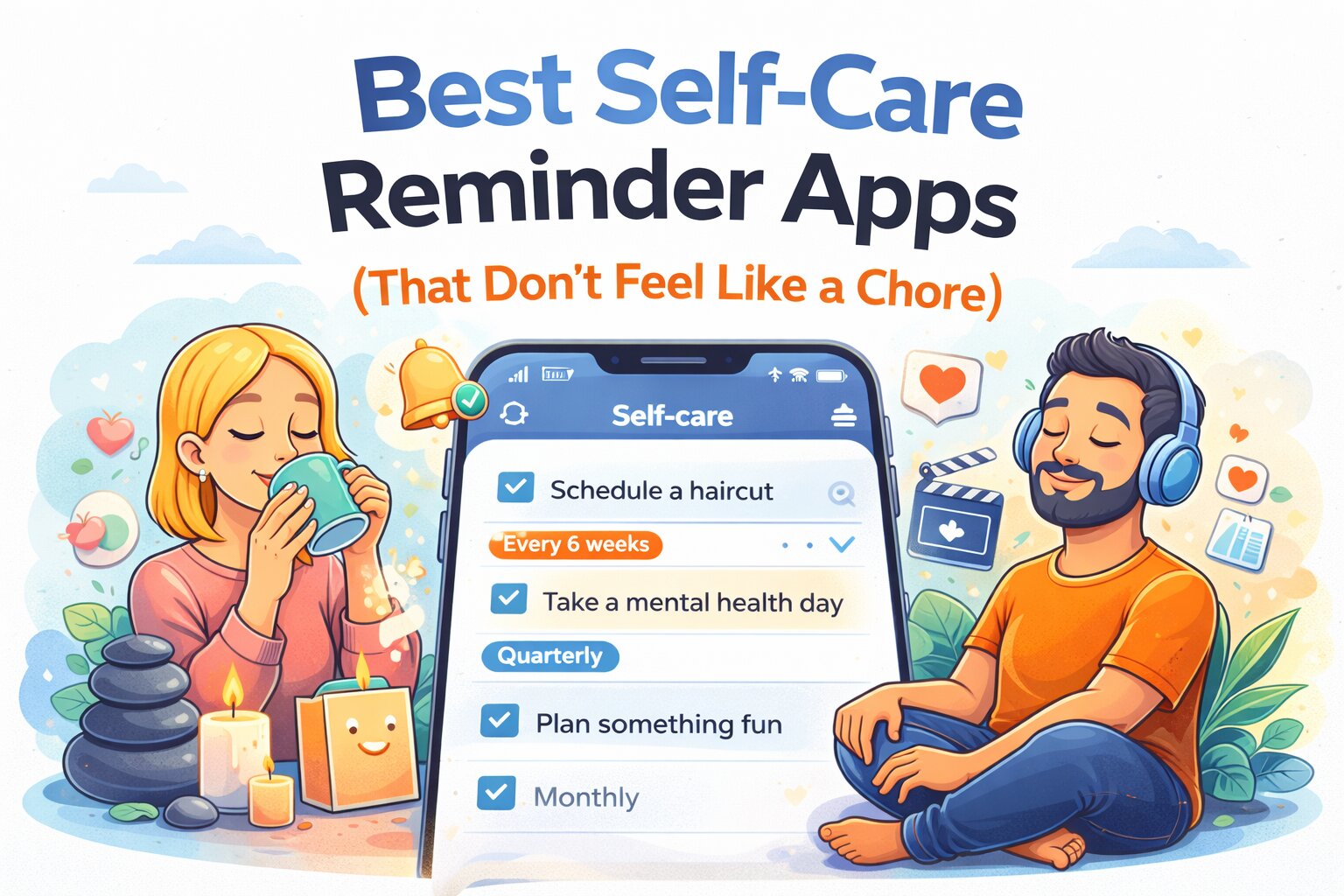
- “Book a haircut every 6 weeks”
- “Get a massage every couple of months”
- “Take a mental health day once a quarter”
- “Check in on your emotions weekly”
- “Plan something fun once a month”
- “Have a movie night each week”
- “Message a friend you’ve been meaning to reply to”
- “Buy yourself something small just because”
Not:
- “Brush your teeth at 8pm”
- “Drink water every hour”
Different category. Different problem.
Built for low pressure
- No streaks
- No guilt loops
- No daily check-ins required
You set it once.
Then forget about it.
Until it shows up at a time you might actually act.
Features that actually help
- Randomised recurring reminders (core feature)
- Custom scheduling windows
- Cross-device sync (iOS, Android, Mac, Windows, Web)
- Works offline
- Google Calendar + Outlook integration
- Device, push, and desktop notifications
- Quick actions (call, message, book, search, links)
- Voice input + note-to-reminder
- Designed to reduce notification fatigue
- Designed to reduce friction in starting tasks
Where it’s not ideal
- strict daily habits
- rigid routines
2. Fabulous
Best for: guided routines and habit building
Pricing: Subscription (~$5–10/month)
Fabulous focuses on building structured daily routines through coaching and guided journeys.
Strengths
- Strong behavioural science foundation
- Motivational design and guidance
- Good for building habits step-by-step
Weaknesses
- Very structured
- Requires daily engagement
- Can feel overwhelming over time
Great if you want structure. Less great if you just want reminders that fit around your life.
3. Finch
Best for: gentle, gamified self-care
Pricing: Free, optional subscription
Finch turns self-care into a game where you look after a virtual companion by completing tasks.
Strengths
- Encouraging and low-pressure tone
- Good for mental health check-ins
- Engaging and friendly design
Weaknesses
- Gamification isn’t for everyone
- Requires regular interaction
- Less focused on real-world task execution
Good for emotional support. Less focused on real-life follow-through.
4. TickTick
Best for: combining habits with reminders
Pricing: Free, Premium ~$3/month
TickTick includes habit tracking alongside tasks and reminders.
Strengths
- Habit tracking + reminders
- Cross-platform
- Flexible task setup
Weaknesses
- Habit-focused (streaks, tracking)
- Recurring reminders are fixed
- Can feel like productivity pressure
5. Any.do
Best for: daily planning and routines
Pricing: Free, Premium ~$5/month
Any.do combines tasks and calendar planning.
Strengths
- Clean interface
- Good for daily organisation
- Easy to use
Weaknesses
- Recurring reminders become repetitive
- Requires active use
- Less suited to long-term self-care reminders
6. Apple Reminders / Google Tasks
Best for: simple reminders
Pricing: Free
Strengths
- Built-in and easy to use
- No learning curve
Weaknesses
- Very basic recurring logic
- Easy to ignore
- No flexibility in timing
They work, but they don’t adapt.
Comparison table
| App | Best For | Recurring Flexibility | Randomised Timing | Low Pressure | Platforms | Price |
|---|---|---|---|---|---|---|
| MaybeLater.Now | Flexible self-care | High | Yes | Yes | iOS, Android, Web, Desktop | Free / $2.99/mo |
| Fabulous | Habit building | Medium | No | Medium | iOS, Android | ~$5–10/mo |
| Finch | Gamified self-care | Medium | No | Yes | iOS, Android | Free / Paid |
| TickTick | Habits + tasks | Medium | No | No | All | ~$3/mo |
| Any.do | Daily planning | Medium | No | Medium | All | ~$5/mo |
| Apple/Google | Simple reminders | Low | No | Medium | All | Free |
Which self-care reminder app should you choose?
- If you want structured routines → Fabulous
- If you want something gentle and gamified → Finch
- If you want simple reminders → Apple / Google
- If you like habits and tracking → TickTick
But if your problem is:
- forgetting non-urgent self-care
- ignoring repetitive reminders
- not having time at fixed moments
- wanting something low pressure
Then you don’t need stricter habits.
You need reminders that fit around your life.
That’s where MaybeLater.Now is built differently.
The real problem with self-care reminders
Self-care doesn’t fail because people don’t care.
It fails because:
- it’s not urgent
- it’s easy to postpone
- and reminders show up at the wrong time
A good reminder system doesn’t force you into routines.
It increases the chance that when the moment comes…
you actually feel like doing it.