The Mental Load Is Real: How Shared Reminders Help
2026-03-30
The Mental Load Is Real. Shared Reminders Help Carry It.
For a lot of couples and families, the work isn’t just doing things.
It’s remembering them.
Remembering the school trip form.
Remembering the dentist appointment.
Remembering to buy a birthday card.
Remembering the bin day.
Remembering to rebook the MOT.
Remembering to message the plumber.
Remembering that someone needs to pick up the prescription.
This kind of work is often called the mental load. It’s the invisible planning, tracking, and organising that keeps life moving.
And very often, it ends up sitting mostly on one person.
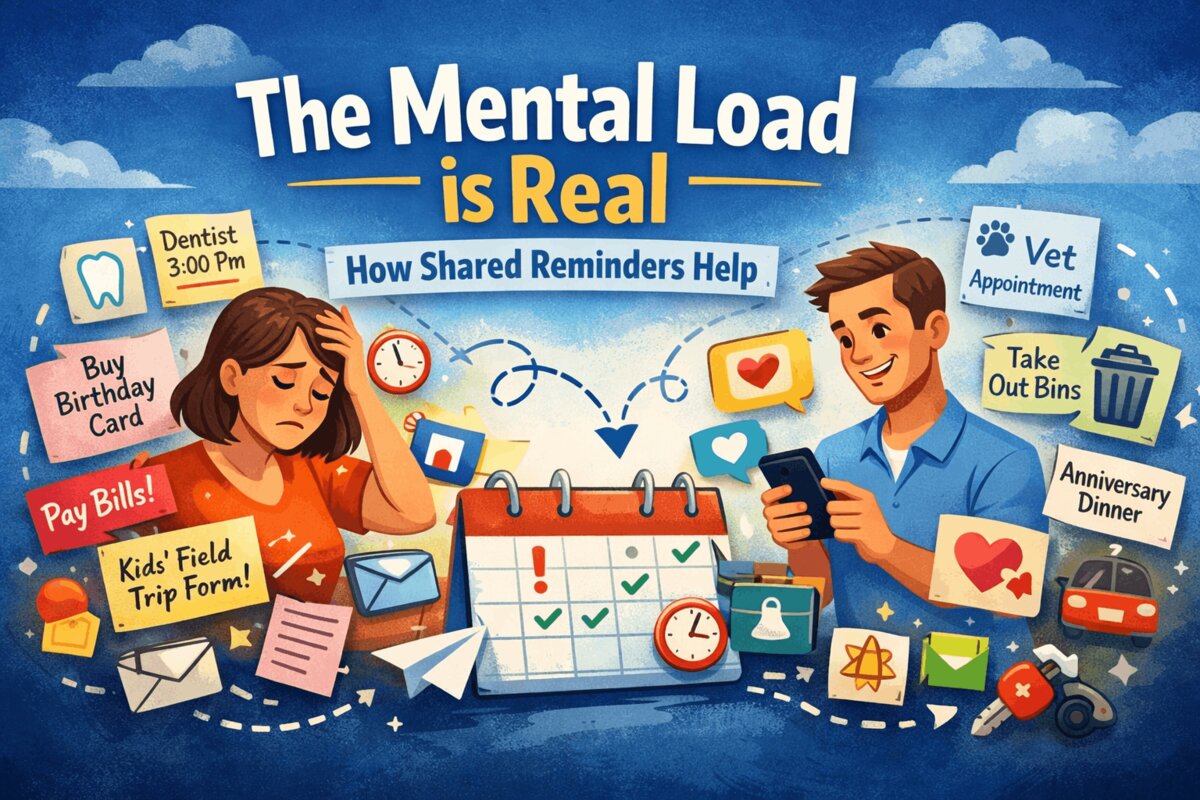
What is the mental load?
The mental load is all the background admin of everyday life.
It’s not always visible because it often happens before anything is actually “done.”
It includes things like:
- noticing what needs doing
- remembering deadlines
- keeping track of appointments
- planning ahead for family events
- following up on unfinished tasks
- reminding other people
- holding all the “don’t forget” details in your head
In a lot of households, one person becomes the default memory system.
They’re the one who knows:
- when the school letters need signing
- when the dog is due at the vet
- when the bills come out
- when the kids need PE kit
- when the birthday party RSVP is due
- when the car insurance renews
Even when responsibilities are “shared,” the remembering often isn’t.
That’s where the imbalance happens.
Why the mental load often falls on one person
When people talk about dividing household labour, they often focus on physical tasks:
- cleaning
- cooking
- laundry
- shopping
But the mental load and invisible labour are different.
Invisible labour is:
- keeping track of what needs doing
- spotting problems before they happen
- planning around future dates
- reminding others
- being interrupted by loose ends all day
That’s why someone can feel completely overwhelmed even if, on paper, the chores look “fair.”
Because being the person who has to carry the reminders is a job in itself.
Why “just tell me what to do” doesn’t solve it
This is one of the biggest frustrations in shared households.
One person says:
“You should have asked.”
Or:
“Just tell me what needs doing.”
On the surface, that sounds helpful.
But in practice, it often means the same person is still doing the invisible work.
Because now they have to:
- notice the task
- remember the deadline
- decide who should do it
- bring it up
- remind again if it doesn’t happen
- keep checking whether it got done
That’s not shared responsibility.
That’s task delegation.
And delegation still creates mental load.
How shared reminders reduce mental load
The goal isn’t just to send reminders.
The goal is to stop one person from being the only one holding everything together.
With shared reminders and a shared calendar in Maybe Later Now, both people can see what’s coming up and what matters.
Instead of:
- one person privately tracking everything
- reminders living in one phone
- calendar events being split across apps
- important things getting mentioned once and forgotten
You get:
- a shared view of upcoming reminders
- a shared calendar for important dates
- reminders that can be assigned or visible to both people
- fewer “I didn’t know about that” moments
- less need for one person to constantly chase the other
That changes the dynamic.
It moves things from:
“I’m responsible for remembering this for both of us.”
to:
“We can both see it, so we can both own it.”
A shared calendar for couples and families makes things visible
A shared calendar for couples or families helps make invisible labour visible.
It gives everyone one place to see:
- appointments
- school deadlines
- bills and renewals
- birthdays
- recurring household tasks
- family events
- reminders that affect more than one person
A shared calendar helps couples and families see appointments, deadlines, school events, bills, and recurring tasks in one place, instead of splitting them across texts, notes, and separate calendars.
That doesn’t magically fix household organisation.
But it does make responsibilities easier to see and easier to share.
It helps with everyday life, not just big events
This matters most in the boring, repetitive, easy-to-forget stuff.
Things like:
- school deadlines
- medication refills
- bills and renewals
- bin days
- after-school clubs
- birthday presents
- parents’ evening bookings
- recurring household admin
- appointments that need follow-up
- “don’t forget to bring…” reminders
These are exactly the things that create friction because they’re small enough to be missed, but important enough to cause stress when they are.
Shared reminders don’t magically make life organised.
They just stop important things from depending on one person’s brain.
That alone can be huge.
Better systems reduce resentment
A lot of household arguments aren’t really about the task itself.
They’re about what the task represents.
It’s not just:
- the missed appointment
- the forgotten form
- the late payment
- the unbought birthday card
It’s the feeling of:
- I had to remember this again
- I had to ask again
- I had to remind you again
- If I don’t think of it, it doesn’t happen
That’s exhausting.
When reminders are shared, expectations become clearer.
Everyone can see:
- what’s coming up
- what matters
- what still needs attention
- who’s handling what
That visibility can remove a lot of the emotional weight from day-to-day life.
Shared doesn’t have to mean complicated
A shared system only works if it’s simple enough to actually use.
That means:
- quick to add reminders
- easy to see what’s coming up
- simple recurring reminders
- a shared calendar that isn’t cluttered
- notifications that are useful, not overwhelming
- one place for family and household reminders
If a system takes too much effort, people stop using it.
That’s why Maybe Later Now is built to make reminders feel lightweight.
The easier it is to capture something when it pops into your head, the less likely it is to become another thing one person is silently carrying.
Shared reminders are not about control
This is important.
A shared reminder system shouldn’t feel like:
- micromanaging
- parenting your partner
- surveillance
- “proof” that someone forgot something
It should feel like support.
A good shared system says:
- here’s what matters
- here’s what’s coming up
- here’s what we both need to know
- here’s how we stop relying on memory alone
That’s not about control.
That’s about reducing friction.
For ADHD, overwhelm, and busy households, shared memory matters even more
If one or both people have ADHD, a lot of this becomes even more intense.
Because the problem often isn’t caring.
It’s:
- forgetting
- time blindness
- losing track of follow-ups
- meaning to do something later and then losing it
- not seeing something at the right moment
That can easily turn into a dynamic where one person becomes the external memory for everyone else.
A shared reminder app or shared household calendar helps because it creates external memory that belongs to the household, not just one person.
That can reduce:
- missed tasks
- repeated reminders
- blame loops
- resentment
- the “why am I the only one thinking about this?” feeling
The goal isn’t perfect fairness. It’s less invisible work.
No app can perfectly split emotional labour.
No calendar can fix communication by itself.
But better systems do make a real difference.
When reminders and important dates are shared:
- less gets lost
- fewer things depend on one person remembering
- responsibilities become more visible
- household admin feels more like a team effort
And that matters.
Because invisible labour is still labour.
If one person is doing all the remembering, they’re doing more than it looks like.
Shared reminders in Maybe Later Now
With shared reminders and a shared calendar in Maybe Later Now, it’s easier to keep important things visible without turning life into project management.
Use it for:
- family admin
- partner reminders
- recurring household tasks
- appointments
- school deadlines
- birthdays and events
- bills and renewals
- the random important things that usually live in one person’s head
Because the goal isn’t to become perfectly organised.
It’s to make sure important things don’t depend on one overwhelmed person carrying them alone.